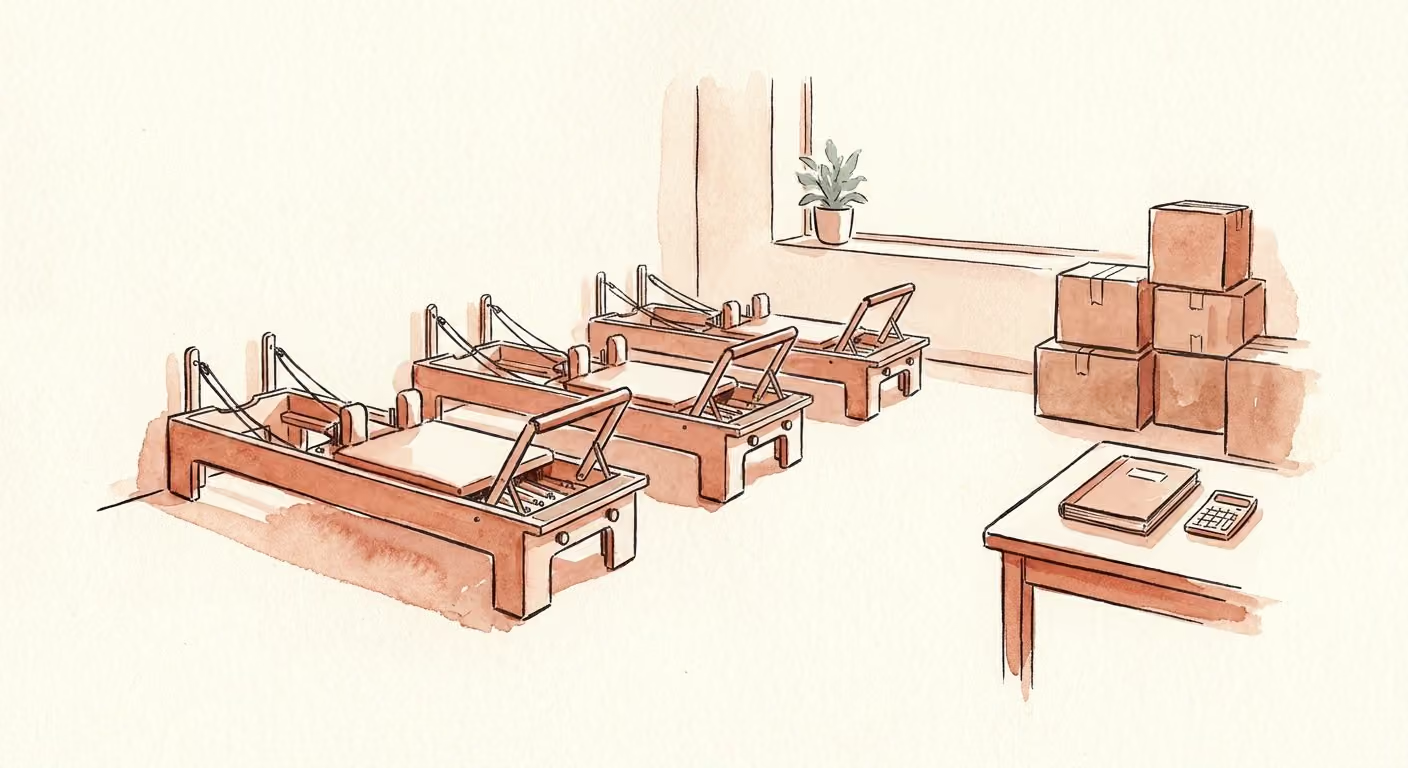
 AI-generated image
The Real Math of a Reformer Studio
Behind the boutique boom sits an unromantic spreadsheet: machines that cost thousands, rent that can eat a fifth of revenue, and a margin that only shows up when the room is full. We go through the sector's real numbers, sourced — without the interview we didn't do.
No one opens a Reformer studio because of a spreadsheet. They open one because Pilates changed their body, because they want to teach what they learned, because they’ve seen a room full at seven on a Tuesday morning and thought that could be theirs too. But behind the vocation sits a very specific economics, and it’s rarely told with real numbers. The strongest, most comparable data we found comes from the U.S. market — the largest and best-documented corner of the boutique sector — so that’s the frame of reference for this piece. It’s cited for what it is: estimates from real-estate, financial and studio-software consultancies, not official figures from any single company.
What It Costs to Open the Door
A boutique Reformer studio needs, according to industry estimates compiled by consultancies that specialize in studio openings, somewhere between $150,000 and $350,000 to open under a standard model; leaner owner-operator versions, with fewer machines and less staff, run from around $80,000. Equipment alone eats up 30 to 40 percent of that initial budget: a new commercial Reformer runs $3,000 to $7,500 today, a used one $1,500 to $4,000; a studio with eight to twelve Reformers needs 800 to 2,000 square feet, and build-out runs $80 to $150 per square foot.
If the chosen model is a franchise — the best-documented route, since it requires reporting figures to a regulator — the scale changes. According to a research note from real-estate consultancy MMCG Invest, total investment to open an SBA 7(a)-financed Club Pilates location in the U.S. runs $385,000 to $839,000, with loan sizes between $308,000 and $671,000. One detail worth flagging for what it says about relative sector risk: the default rate on those specific Club Pilates loans sits around 4.5 percent, well below the 9.9 percent average across all franchises.
What It Takes for the Room to Turn a Profit
Revenue, once a studio matures, depends almost entirely on the monthly rate and how many people pay it. According to the same consultancy, average revenue per active member sits between $200 and $260 a month; unlimited memberships range from $199 in suburban Midwest markets to $359 in the priciest coastal locations, and a single drop-in class can run $25 to $49 or more in New York or California. At those price points, an independent studio’s annual revenue runs from $850,000 — in saturated markets like Los Angeles County — to more than $1.2 million in markets competition hasn’t yet caught up to.
None of that automatically translates into profit. Rent eats 9 to 13 percent of revenue in secondary markets, and can climb to 15 to 20 percent in the most saturated coastal areas. Instruction — paying teachers by the hour or per class — runs $34 to $41 an hour according to job-platform data, with annual pay between $48,000 and $86,000. With that cost structure, top-quartile studios reach mature EBITDA margins of 22 to 28 percent; premium corporate-owned concepts, 28 to 35 percent. The margin exists, but it demands high, sustained occupancy — not one full room on a random Tuesday.
The margin exists, but it demands high, sustained occupancy — not one full room on a random Tuesday.
A Myth Worth Retiring
A number circulates through the industry, repeated across dozens of articles: that 81 percent of boutique studios close within their first year. It sounds plausible, it’s almost always attributed to IHRSA — the international health-club association — and we couldn’t trace any report, survey or dataset that backs it up. Its most likely origin is an offhand remark in a 2018 webinar, repeated afterward without verification from article to article until it hardened into industry common sense. The numbers that do have a traceable source — U.S. Bureau of Labor Statistics data on small-business survival in general — put first-year closures at around 20 to 22 percent: a high figure, but nowhere near 81. We’d rather not repeat the one we couldn’t verify, even if it makes the better headline.
What does support the sector’s growth is data with a clear source: in 2025, Pilates was the most-booked activity on ClassPass worldwide for the third consecutive year, with Reformer bookings up 71 percent year over year. Nearly twelve million people practiced Pilates in the U.S. in 2023, up 15 percent from the year before. The demand is real. The question every new studio has to answer with its own books — not the competition’s, not the sector’s — is whether, at those prices and those costs, the arithmetic works out in its favor too.
Field Notes
- 30–40%Share of the initial budget that goes to Reformers and equipment alone.
- 22–28%Typical mature EBITDA margin for top-quartile studios, per real-estate and financial sector estimates.
- $850K–$1.2MEstimated annual revenue of a mature independent studio, depending on market saturation.
- 20–22%Actual first-year small-business closure rate in the US (BLS) — versus the unverifiable 81% figure circulated for boutique studios.