The Exact Inches Pilates Put in Writing
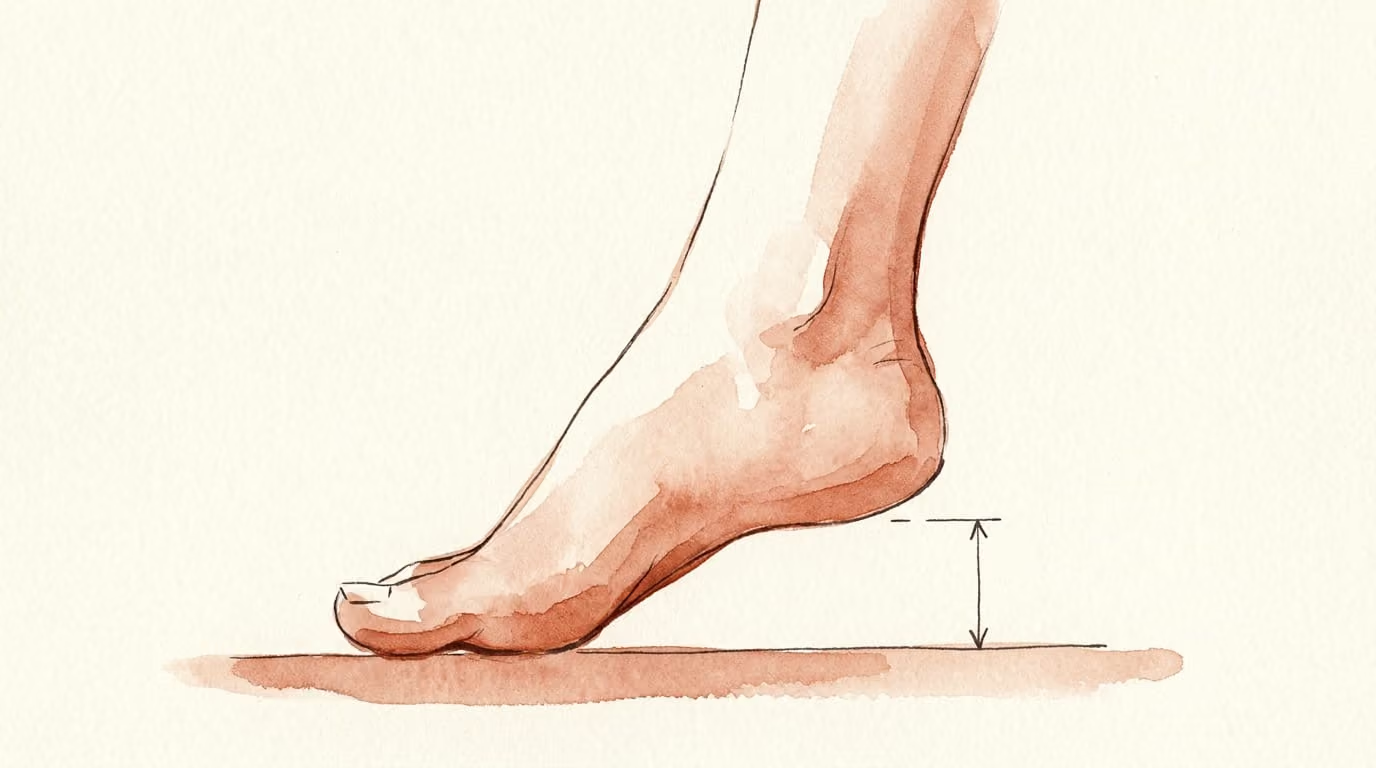
Raise your feet 2 inches. Arms move 6 to 8. Never exceed 100 repetitions. The 1945 book doesn't speak in generalities: it quantifies almost every instruction with a precision that would surprise most classes today.
Walk into an intermediate Pilates class today and you’ll likely hear instructions like “lift your legs a little higher” or “take your arms as far as feels comfortable.” It’s reasonable language, adapted to each body. It’s also, compared to the original, surprisingly imprecise. Because the book Joseph Pilates published in 1945 didn’t talk like that. It talked in inches.
A precision that borders on obsessive
The instructions for the Hundred, the book’s first exercise, don’t say “raise your feet slightly”: they specify raising both feet “about 2 inches” off the mat, then raising both arms “about 6 to 8 inches above the thighs,” pumping them through that same range. The Double Leg Stretch asks for ankles raised roughly two inches off the mat. The Double Kick specifies legs raised about an inch. The Jackknife asks the spine to lift off the floor about 5 inches before the kick. None of these figures is decorative: line by line, they’re the difference between executing the exercise as Pilates designed it and executing a loose approximation of it.
The book doesn’t say “raise your feet a little.” It says two inches.
The ceilings are part of the instruction too
The precision isn’t only geometric — it’s also numerical, and in a sense that would feel counterintuitive today. The Hundred doesn’t just specify how to start (“begin by doing only 20 movements”) and how to progress (“gradually increase in increments of 5 movements”), it explicitly sets a ceiling: never exceed 100 repetitions. In today’s training culture, where “more” is usually read as a synonym for “better,” an instruction that expressly forbids going past a number is almost a rarity. For Pilates it wasn’t: in the philosophical chapter that precedes the exercises, he had already warned against overexertion — there is no reason to force the body beyond what is necessary and reasonable, especially when doing so causes harm. The ceiling isn’t a generic safety limit. It’s a technical instruction, in the same category as an inch or a repetition.
What to do with this in the studio today
No one is suggesting an instructor should carry a tape measure into class. But there’s something worth recovering in that precision: the idea that the quality of a Pilates exercise doesn’t depend on how much range of motion the student reaches, but on whether that range is exactly what the exercise asked for — no more, no less. It’s, at bottom, the same logic that holds up all of Contrology: control before amplitude, exactness before effort. The 1945 book didn’t leave that idea as an abstract line of philosophy. It wrote it down in inches, so no one would have to guess.
Field Notes
- 2 inExact height the book asks you to raise your feet off the mat at the start of the Hundred — not 'a little,' two inches.
- 6-8 inRadius of the arm-pumping motion specified for the Hundred, used as a reference across several pumping exercises.
- 100Repetition ceiling fixed for the Hundred, with an explicit instruction never to go past it.