The Classical Order: Why the 34 Exercises Go in That Sequence and No Other
Return to Life Through Contrology isn't a list of 34 standalone exercises: it's a sequence. Read start to finish, it reveals a progression logic that's rarely explained in class — and that explains why changing the order changes the exercise.
Open any modern mat Pilates manual and it’s rare for the 34 classical exercises to appear in the same order across two different schools. Every training center has its own variation, its own progression logic, its own way of adapting the sequence to the group’s level. What almost nobody does is go back to the source: open the 1945 book and read the 34 exercises exactly in the order Pilates chose to print them. Doing so reveals something the text itself never explains directly, but that becomes completely clear reading it start to finish: it isn’t a list, it’s a sequence with an internal logic.
Start with the blood, not the strength
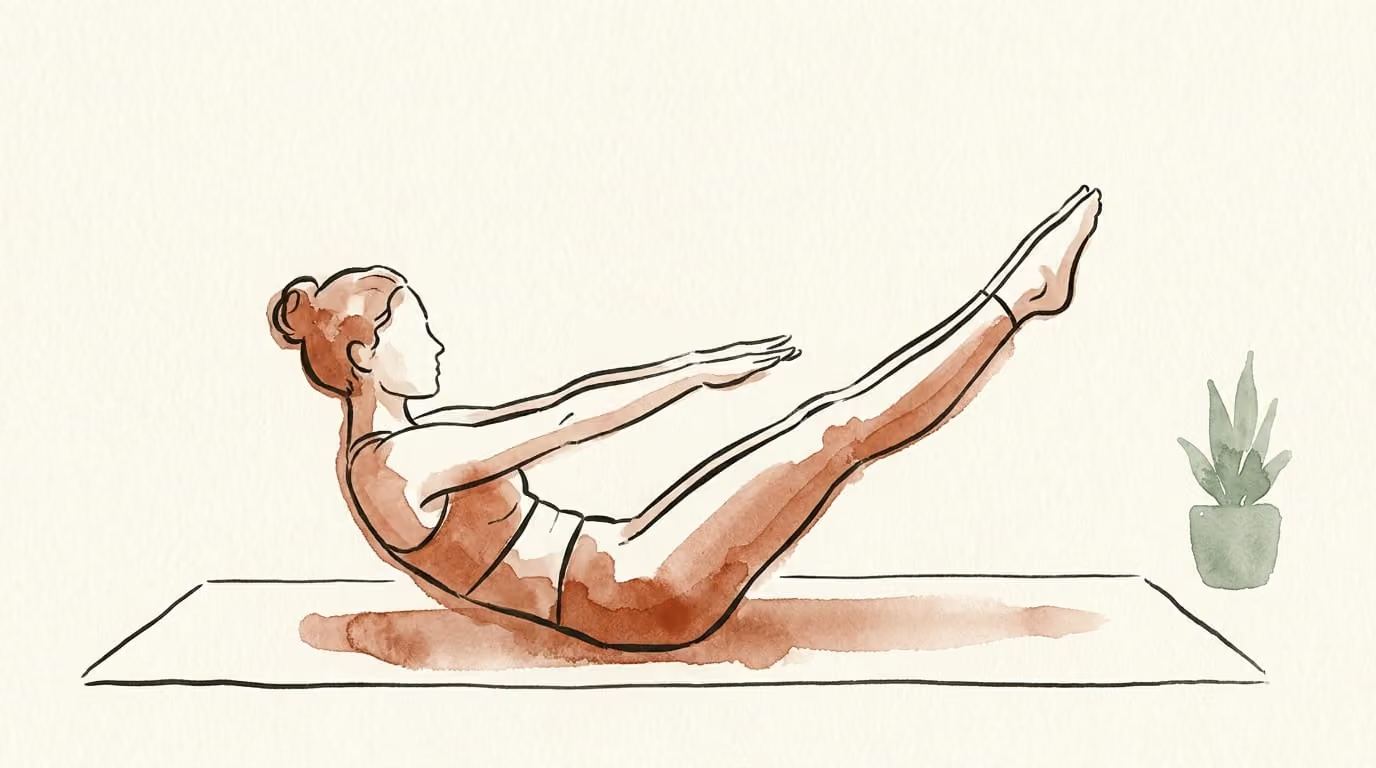
The book’s first exercise is the Hundred — and not by accident. The entire philosophical chapter that precedes it insists on blood circulation as the central mechanism of Contrology: “Contrology exercises purify the blood in the bloodstream and whip it into instant action,” Pilates writes, comparing it to a rainstorm that freshens a sluggish, stagnant stream. The Hundred — arm pumping, forced breathing in short bursts — fits exactly that function: it isn’t the hardest of the 34, but it’s the one that fastest raises the pulse and activates the full breathing the preceding chapter spends twenty pages demanding. Starting there isn’t pedagogical chance. It’s physiology applied on purpose.
It isn’t a list of 34 exercises. It’s a sequence with an internal logic, and reading it straight through proves it.
The middle stretch: teaching the spine to “roll”
From roughly the second to the twentieth exercise, the book works almost obsessively on a single motor pattern: “rolling” forward and back, vertebra by vertebra. Roll Up, Roll Over, Rolling Like a Ball, Open Leg Rocker, Corkscrew, Jackknife, Neck Pull — all of them reuse the same base instruction, with leverage variations (legs more or less apart, arms free or held) that raise the demand without changing the pattern. It is, in essence, a block of repetition with variation — the same pedagogical logic any modern strength program would use to automate a complex movement before complicating it further. Pilates didn’t have that vocabulary in 1945. But the sequence he left in writing behaves exactly like that.
The final stretch: balance, not repetition
The book’s last exercises — Kneeling Side Kicks, Boomerang, Seal, Crab, Rocking, Balance Control, Push Ups — barely repeat the solo “rolling” pattern anymore. Instead, they demand holding balance on a reduced base (one knee, the hands, a moving sacrum) while the rest of the body moves. It’s the kind of demand that only makes sense to ask for after the body has already automated spinal control in the previous stretch — asking for it at the start would simply be premature. The book itself seems to know this: in the Side Bend, one of the few notes that mentions a timeframe, it instructs the reader to progress to a harder position after a month of practice, explicitly acknowledging that there is a temporal progression even within a single exercise.
Why this matters today
No one is obligated to teach the 34 in the exact order of 1945 — the method itself has evolved, rightly, across eighty years of clinical and pedagogical practice. But knowing the original logic changes the conversation: adapting a sequence while knowing which progression principle you’re breaking is not the same as doing it having never read what that principle was. The 1945 book doesn’t give a theoretical explanation for why the order is what it is. It gives it through the order itself.
Field Notes
- 1stThe Hundred, the exercise that opens the sequence in the 1945 book — designed as circulatory activation and warm-up, not a strength challenge.
- 34thPush Ups, the book's final exercise — integrates arms, legs and trunk control, sustained by the body's own weight.
- 100Maximum repetition count the book itself sets for the Hundred — the cap that gives the exercise its name.