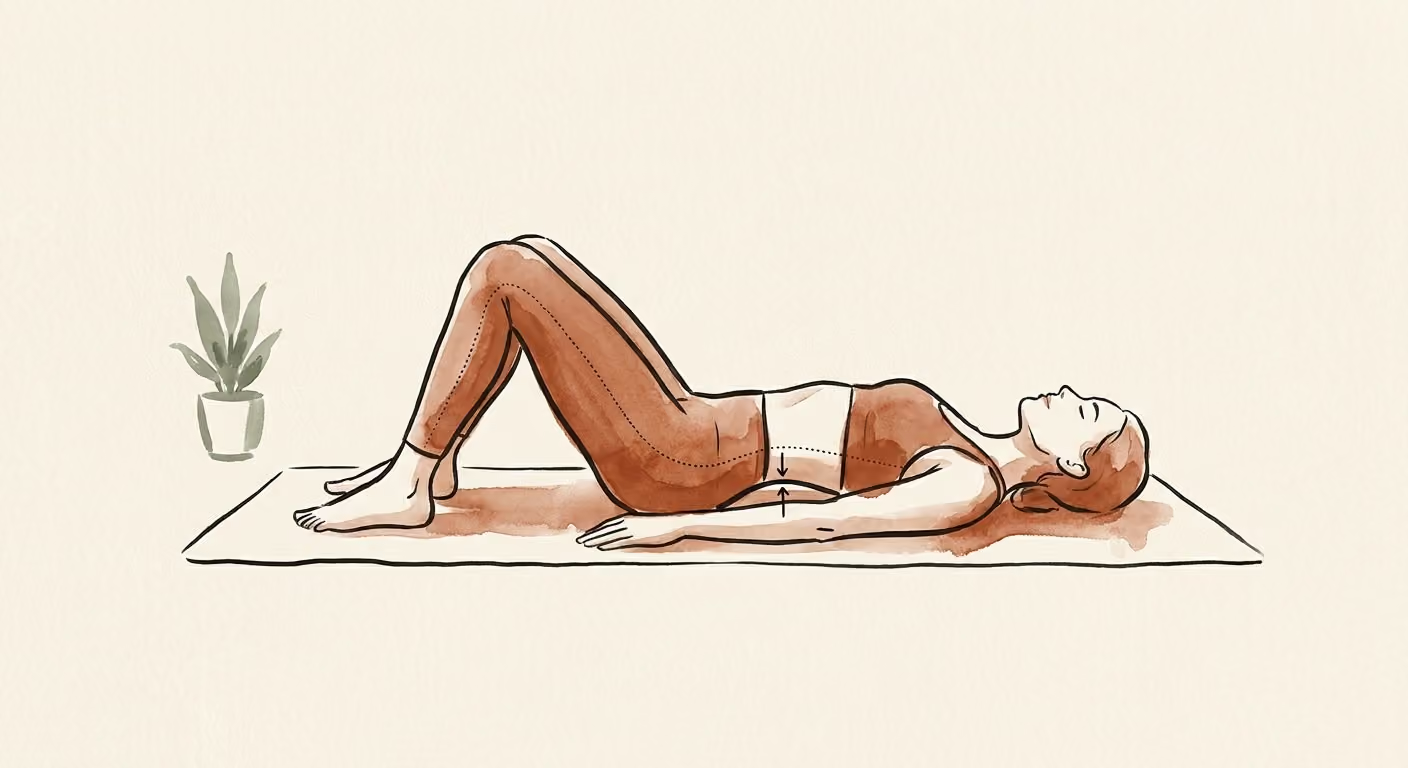
 AI-generated image
Neutral Spine, Explained Without the Jargon
'Keep it neutral' is the mantra of any Pilates or strength class. It's a good default position, not a suit of armor — and there are moments, even within the method itself, when abandoning it is the right call.
Informational content; it does not replace advice from a healthcare professional. More
“Keep your spine neutral” is probably the most repeated instruction in any Pilates studio, and one of the most cited in any gym. It’s taught as if it were a fixed, sacred position — the only safe way to move a back. Biomechanics describes something more nuanced: a zone, not a point, with a clear function and also with limits that rarely get explained in class.
What Neutral Actually Is
Biomechanist Stuart McGill defines it as the posture in which the joints and the passive tissues surrounding them sit in elastic equilibrium, requiring the least muscular effort to maintain. Before him, researcher Manohar Panjabi introduced the concept of the “neutral zone” in 1992: the region around a vertebra’s central position where movement occurs with very little tissue resistance. It isn’t a millimeter-precise point to find and freeze — it’s a range. When that zone widens — through injury, muscular weakness, or disc degeneration — that’s what’s meant by clinical instability, one of the few genuinely medical uses of a term that gets thrown around, far less precisely, on gym floors.
What It Protects — and What It Doesn’t
The logic behind seeking neutral has a real basis: it distributes load more evenly across the intervertebral disc and reduces shear stress on the facet joints, compared with heavily flexed or extended positions under heavy load. But “neutral” isn’t foolproof armor. Laboratory studies on vertebral segments have shown that disc herniation can occur even in neutral postures when the disc is pressurized enough, and that vertebral endplate fracture under compression happens at high loads and loading rates relatively independent of the spine’s exact position. Neutral reduces risk in certain scenarios; it doesn’t eliminate it, and it’s certainly not the full explanation for why a back hurts.
Neutral spine isn’t armor: it’s a useful starting position, especially under heavy or repetitive load. On its own, it doesn’t explain all back pain.
When Neutral Isn’t Actually the Goal
Pilates itself is proof that spinal flexion isn’t inherently dangerous: classic exercises like the Roll Up or Rolling Like a Ball ask for the exact opposite of neutral — articulated, vertebra-by-vertebra flexion, trained in a controlled, progressive way. Everyday human movement isn’t neutral either: a deep squat involves roughly 40 degrees of lumbar flexion, a kettlebell swing about 26, a good morning close to 25 — degrees that show up even when someone actively tries to stay “neutral.” Disc herniation, moreover, explains only 2% to 5% of low back pain cases, so a strategy that avoids flexion at all costs is guarding against a minority cause while feeding a fear of movement — kinesiophobia — that the evidence links to worse outcomes, not better ones. Neutral matters most under heavy, repeated load, or when pain is active; it matters far less — and training controlled flexion has value of its own — in everyday movement and in the progressive articulation that Pilates itself has been teaching for a century.
A Starting Position, Not a Final Destination
Teaching neutral as an initial reference point — the place from which a beginner learns to feel their spine before loading it — remains pedagogically sound. Turning it into the only permitted position, and flexion into a danger to avoid always, doesn’t have the backing its repetition in class suggests.
Field Notes
- 1992The year Manohar Panjabi introduced the spine's 'neutral zone' concept, still central to the biomechanics of vertebral stability.
- ≈40°Approximate lumbar flexion during a deep squat, even when someone actively tries to keep the spine 'neutral.'
- 2–5%Share of low back pain cases the biomechanical literature attributes specifically to disc herniation.