The Anatomist Who Brought the Method to Spain
While the English-language press ignores Pilates' Spanish lineage, Spain has its own origin story — and it runs through an Anatomy professor and a direct heir of Joseph Pilates.
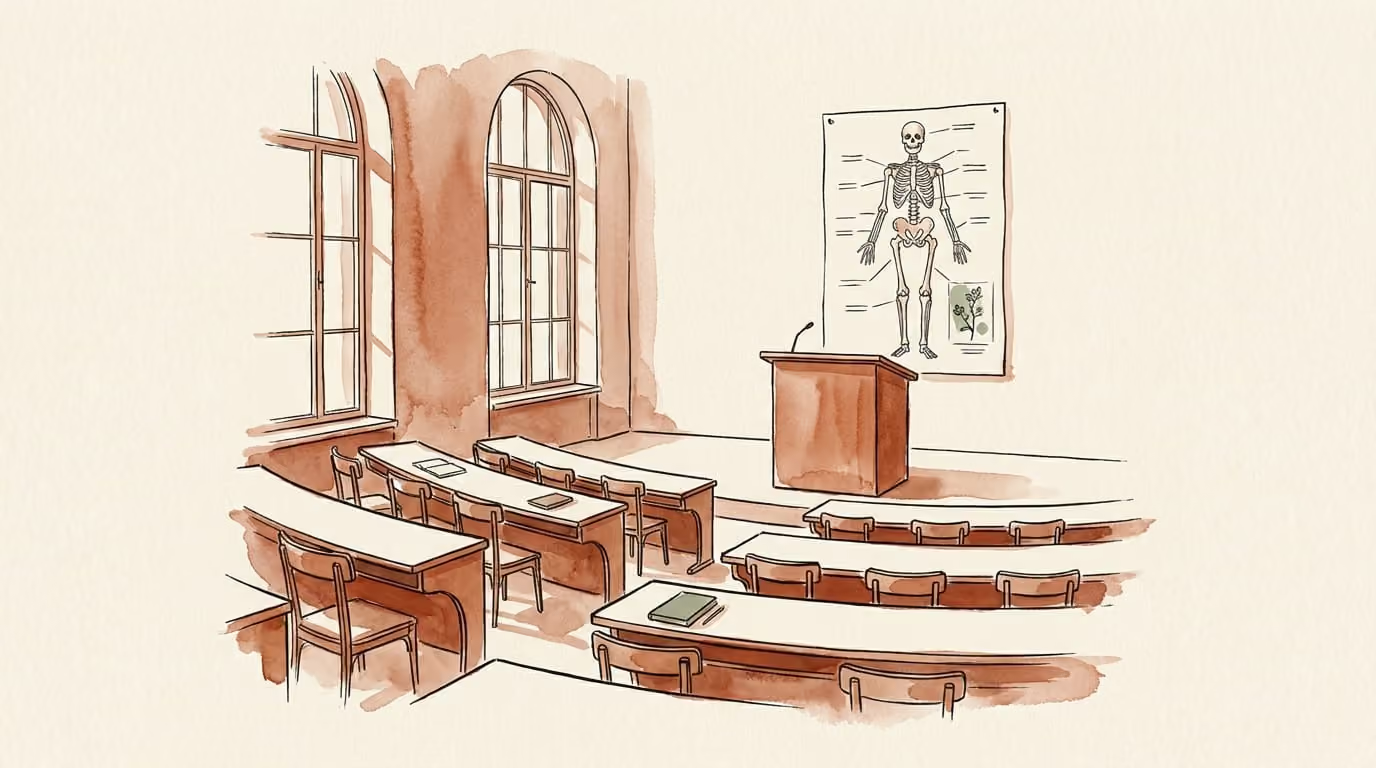
The official history of Pilates is almost always told in English: New York, the Elders, Hollywood. But there’s a Spanish chapter that rarely crosses our borders, one that begins in an unglamorous place — an anatomy classroom — with an unlikely figure: Dr. Juan Bosco Calvo, professor of Human Anatomy at the Universidad de Alcalá.
In the early nineties, Calvo noticed something that caught his attention: American dance companies visiting Spain trained with a method that was barely known here. Rather than import it secondhand, he went to the source. In 1993 he invited Romana Kryzanowska — guardian of the classical method and one of Joseph Pilates’ direct heirs — to teach courses in Madrid and Valencia. This wasn’t a franchise or a fad: it was transplanting the lineage through one of its most legitimate keepers.
He didn’t import the method secondhand: he went to the source and brought back a direct heir of Joseph Pilates.
From that impulse came Corpora Pilates, the project Calvo developed with Laura Cabral, which went on to expand to more than three hundred centers in Spain, Portugal, Colombia, Argentina and Peru. In other words: the spread of Pilates across the Spanish-speaking world wasn’t a stray overflow of the English-language boom, but a deliberate operation, with academic rigor and a clear chain of custody back to Joseph Pilates himself.
This is exactly the kind of story Movente exists to tell. The international trade press treats the Spanish-speaking world as a translation market; we treat it as what it is — a territory with its own genealogy, with names, dates, and a public university at the center of the story. In upcoming issues we’ll follow that thread: the studios that inherited that seed, the tensions between classical and contemporary, and the voices — clinical, academic, teaching — that rarely make it into English. We start with Alcalá because every origin story deserves to be told from its source.