Issue 00moventemag.com
Movente
Pilates · Movement · Culture
The art and science of movement.
The art and science of movement.
Letter from the Director
Pilates has never been more fashionable, or worse told. It has become the most reserved workout in the world and, at the same time, a noise of social-media aesthetics, brand promises and interchangeable tutorials. What's missing is the middle ground: a serious, well-made place with judgment, that treats the method for what it is — a discipline with its own history, science and culture.
And in Spanish, that place simply didn't exist. Anyone looking for depth got school blogs, equipment-brand content, or a newsstand magazine translated from Portuguese. Movente exists to fill that gap, straddling Spain, Latin America and the English-speaking world, without being anyone's translation.
Our only editorial rule is honesty. The evidence on Pilates is genuinely uneven — solid on some things, moderate on others, nonexistent on several — and we will always say so, even when it sells less. We don't sell the burn: we frame the poise.
Giacomo StellaMovente · Issue 00
Contents · Issue 00
Before conquering Hollywood and social media, the method was born where no one would look for it: in a World War I internment camp, tying bed springs to infirmary bedframes.
Pilates is prescribed today for almost everything. We go through the meta-analyses with an uncomfortable rule: separate what's proven from what sells, and say out loud where the evidence ends.
While the English-language press ignores Pilates' Spanish lineage, Spain has its own origin story — and it runs through an Anatomy professor and a direct heir of Joseph Pilates.
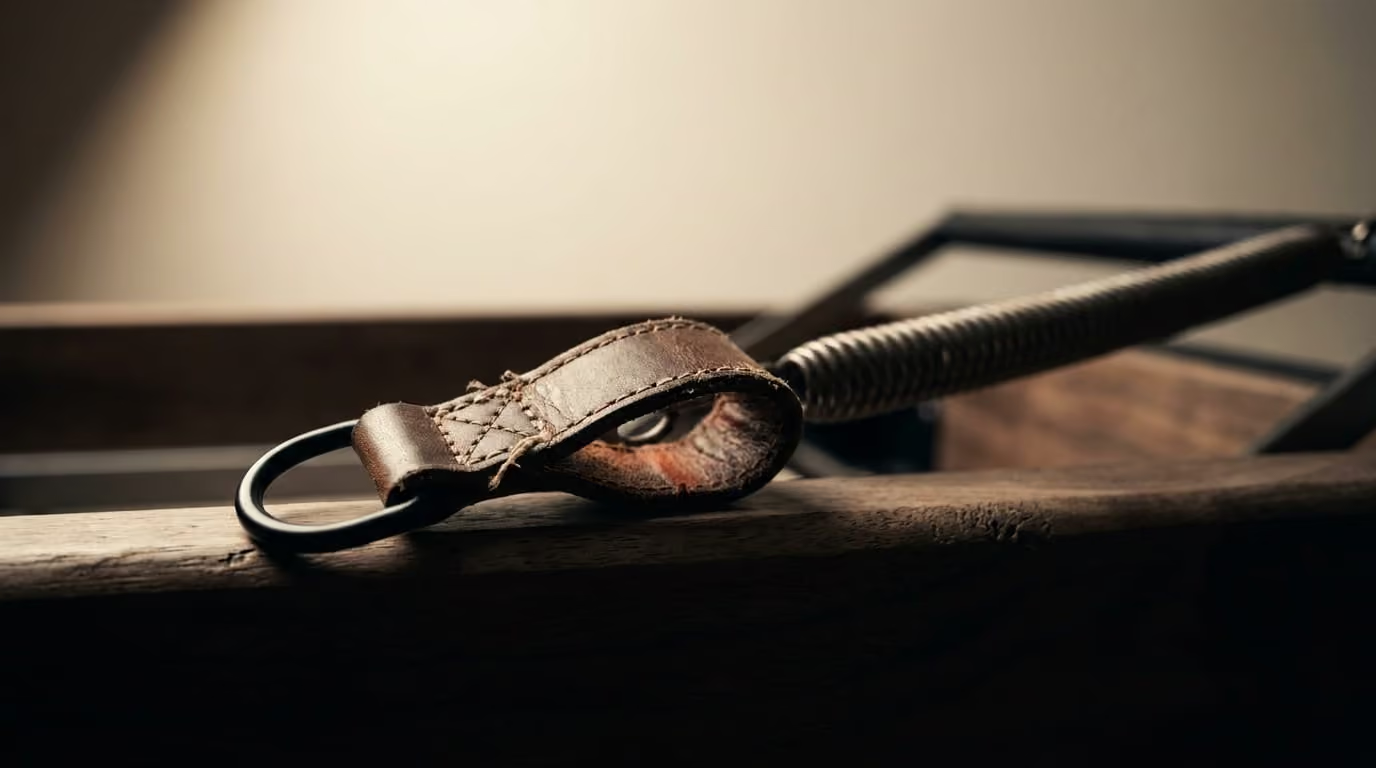
Before it became the apparatus that defines any group class, it was a hospital bed with springs tied to the foot end. We trace the patent, the workshops, and the modifications — from Gratz to Balanced Body — that turned that wartime gesture into a multi-billion-dollar industry.
In the United States, where insurance pays for physical therapy and almost never pays for Pilates, the question isn't rhetorical. An honest answer about where one profession ends and the other begins.
Physical therapy has a state board and a licensing exam behind it. Pilates has a dozen private schools, each setting its own bar for what counts as enough. Almost no one explains that before you book your first class.
Pilates has spent years winning the marketing argument on chronic low back pain. Compared head-to-head with conventional strength training, the advantage it promises shrinks considerably — and in several direct trials, it disappears.
In the summer of 2000, Joseph Pilates' direct heir sat in a Manhattan courtroom and answered a routine question. Her answer sank the legal monopoly on the method's name — and opened the door to the industry we know today.
It began as a reinforced table strapped with springs, built for the bodies the Reformer couldn't fix. Seventy years later it's the most photographed apparatus in any Pilates studio — and probably the least understood.
Joseph Pilates called it the powerhouse. Four generations of instructors turned it into a belt of muscle you have to 'activate' before you move. Biomechanics tells a messier and far more interesting story.
In the spring of 1926, Joseph Pilates landed in New York without a studio of his own. What he found at 939 Eighth Avenue was a boxing gym — and there, among fists and injured dancers, his first clientele took shape.
Forty dollars a class, waitlists, a vocabulary of 'quiet luxury' applied to sweat. How the method born of a man locked in an internment camp ended up as the new way to wear wealth — and what gets left out.
Colofón
ISSN 3127-5419. Movente, issue zero. Texts are based on real documentary research; industry figures are public references. This is not advertising for any entity; Dr. Juan Bosco Calvo's profile is built from documentary sources, with no direct quotes attributed to him. Illustrations are original to Movente.